
Cincinnati Uncontested Divorce Lawyer
 An uncontested divorce lets you and your spouse decide the terms yourselves, with the court reviewing them instead of deciding them for you. In Ohio, it is a divorce where both spouses agree on every issue, but those terms only become binding when a judge approves them, and either of you can still change course before then. A Cincinnati uncontested divorce lawyer helps you build an agreement precise enough to carry through to the decree. WSM Law represents women across Cincinnati and Hamilton County as part of our Cincinnati divorce practice. Call (513) 224-5427 or contact us to schedule a free consultation.
What Counts as an Uncontested Divorce in Ohio?
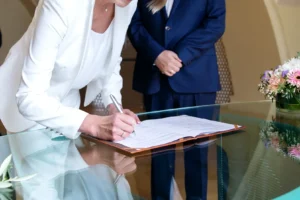
Ohio offers two agreed routes. In a dissolution, both spouses sign one petition with a separation agreement attached under Section 3105.63 of the Ohio Revised Code. In an uncontested divorce, one spouse files a complaint on a ground the other does not fight.
Section 3105.01 lists two grounds that do not require proving fault: incompatibility, which is available unless either spouse denies it, and living separate and apart without cohabitation, without interruption, for one year.
That second ground matters when the first one falls away, because a spouse who later denies incompatibility does not erase a year of living apart. Ohio also lists fault grounds, such as adultery or extreme cruelty, but an agreed case does not have to prove that anyone was at fault.
What Your Agreement Needs Before Filing
A dissolution cannot be filed until the separation agreement settles:
- How all property and debts will be divided
- Whether either spouse will pay spousal support, and on what terms
- Parenting terms for any minor children, including parental rights and responsibilities, the residential parent and legal custodian, child support, and parenting time
Parents can attach a shared parenting plan instead of naming one residential parent.
Filing an Agreed Case in Hamilton County
Under Section 3105.03, the spouse who files for divorce must have been an Ohio resident for at least six months, and the case goes to the proper county under the Ohio Rules of Civil Procedure, generally one where the filing spouse has lived for at least 90 days. For Cincinnati residents, agreed cases are heard by the Hamilton County Domestic Relations Court at 800 Broadway.
After a dissolution petition is filed, the court may order an investigation under the Rules of Civil Procedure, and the resulting report is part of what the court reviews before approving your agreement. If a divorce is already pending and the two of you reach a full agreement, Section 3105.08 lets you jointly convert it into a dissolution before final judgment, with no new filing fees.
What Happens at the Dissolution Hearing?
Under Section 3105.64, both spouses appear no fewer than 30 and no more than 90 days after filing and confirm under oath that they signed the agreement voluntarily, are satisfied with it, and want the marriage dissolved. Under Section 3105.65, the court reviews that testimony and any investigation report it ordered, then may approve the agreement and grant a decree that incorporates it.
The decree has the same effect on property rights as a divorce decree, including dower and inheritance rights, and the court keeps full power to enforce it. If your spouse later ignores a term, the decree gives you a court order to enforce rather than a private promise.
What If Your Spouse Stops Agreeing?
Either spouse can change course before the decree. If one of you arrives at the hearing dissatisfied or no longer wants a dissolution, and no one moves to convert, the court must dismiss the petition. Either spouse can instead convert the case to a divorce by motion, with a complaint stating proper grounds, at any time before the decree, and no court fee is charged for that conversion.
Neither risk is a reason to avoid an agreed case. Even an amicable divorce ends a legal and financial partnership, so the paperwork has to be right. At WSM Law, the goal is a decree that gives everyone what they think they agreed to and holds up if things become less amicable later.
Agreed Divorce When You Have Children
Your agreement about the children is reviewed, not rubber-stamped. When a dissolution includes a shared parenting plan, the court reviews the plan under the same standards Ohio uses in any custody case, and Section 3109.04 requires the court to take into account the best interest of the children. Clear terms on schedules, school decisions, and how future changes will be handled give the court what it needs to approve the plan and give your family a framework that works after the hearing.
What Can Change After the Decree?
Some terms stay open and some do not:
- Parenting terms and child support: The court keeps authority to modify them as circumstances change.
- Spousal support: It can be modified only if the agreement allowed it.
- Property division: It can be changed only with both spouses’ express written consent.
Deciding which terms should stay flexible is a choice made in the agreement, before the hearing. Once the decree is entered, a support term you made final, or a property split you both signed off on, is difficult to reopen. As a firm that represents only women, WSM Law focuses its review on the terms that are easy to give up when a divorce feels friendly and hard to win back later.
Talk With a Cincinnati Uncontested Divorce Lawyer
You can keep your divorce agreed and still protect yourself if plans change. Call (513) 224-5427 or contact us today to schedule a free consultation with WSM Law, and work with a Cincinnati uncontested divorce lawyer on an agreement written to hold.
Today
Schedule Your
Free Consultation
You do not need to have everything figured out before you call. Our attorneys will answer your questions during the consultation, including:
- What the process looks like in your state and a general timeline
- What your case is likely to cost at each stage
- What you can do right now to protect your finances and your children
- What your strongest path forward looks like


Call For A Consultation 513-224-5427
©2026 WSM • All Rights Reserved
